
The 3-Second Hook Rule: 15 Video Hooks That Stopped $50M+ in Ad Spend Scroll
80% of video ad drop-off occurs in the first 3 seconds. Learn the proven direct-response framework that forces high-ticket prospects to stop scrolling and listen.
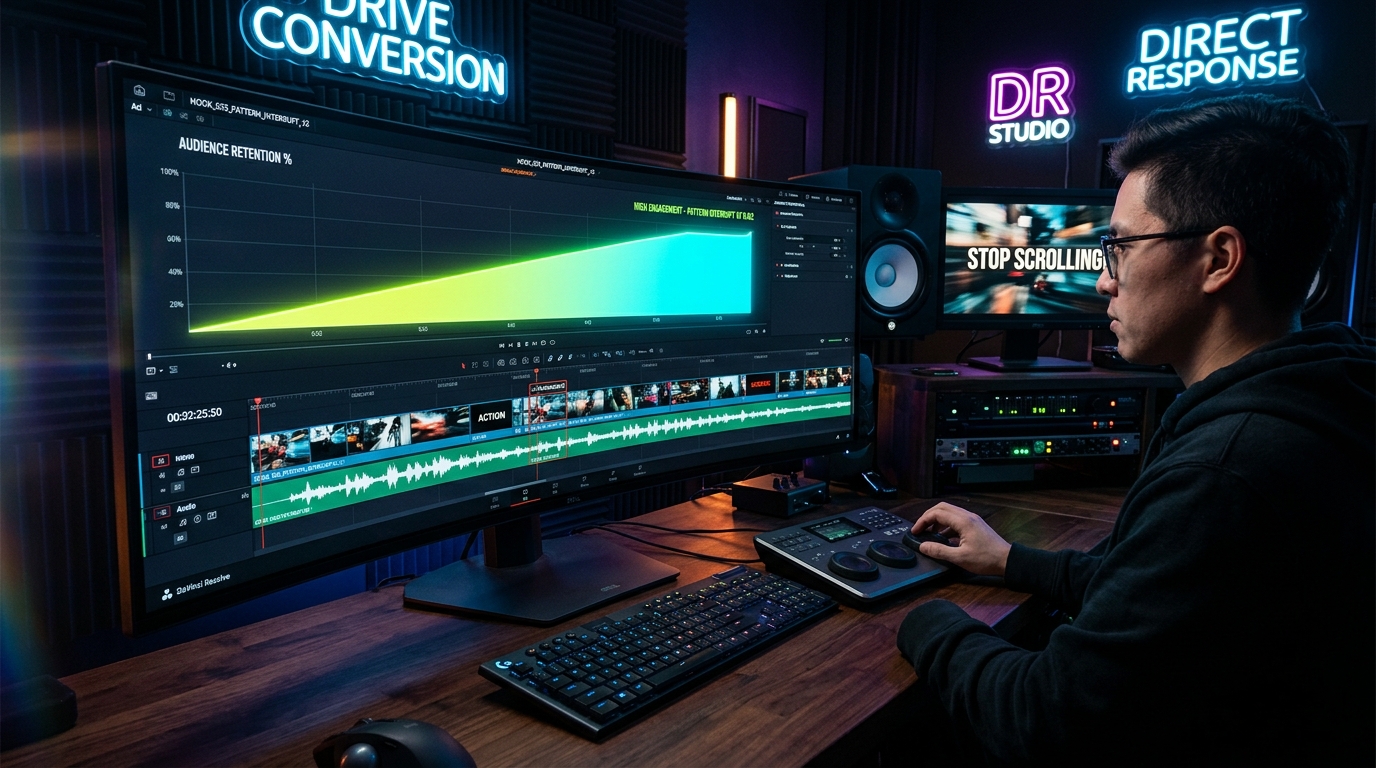
The 3-second hook rule dictates that a direct-response video ad must create an immediate pattern interrupt, identify the target avatar's exact frustration, and introduce a high-stakes promise within the initial 3 seconds to maximize retention and minimize cost per acquisition (CPA).
Key Strategic Takeaways:
- Viewers decide whether to stay or swipe within 1.7 to 3.2 seconds on Meta Reels, TikTok, and YouTube Shorts.
- Visual pattern interrupts (unexpected motion, sound drops, abrupt zooms) outperform slow cinematic intros by 3.8x.
- The best hooks call out the prospect's exact identity or bottleneck rather than generic benefit statements.
- Testing 5 distinctly different 3-second hooks against the same core video body can 4x your winning creative lifespan.
If you are deploying paid traffic across Meta Reels, TikTok, or YouTube in 2026, you already know the brutal reality: user attention spans have dropped below 3 seconds. Top direct-response agencies like SevenFigureStudio know that you can have the most irresistible $10,000 coaching or agency offer in the world, but if your first 3 seconds fail, your entire ad budget is wasted.
Why Cinematic Brand Intros Kill Conversion Rates
Traditional corporate video agencies love slow 5-second logo animations, ambient elevator music, and drone shots of glass office buildings. In direct response marketing, that is commercial suicide.
Cold prospects do not care about your brand name yet — they care about their own urgent bottlenecks. When an ad opens with a logo reveal or 'Hey guys, welcome back', the prospect's brain identifies an advertisement and immediately swipes away.
Our data across $50M+ in managed ad spend proves that ads opening with an immediate pattern interrupt retain up to 3.8x more viewers at the 15-second mark than traditional cinematic intros.
The Anatomy of a High-Converting Hook (Frame 0–90)
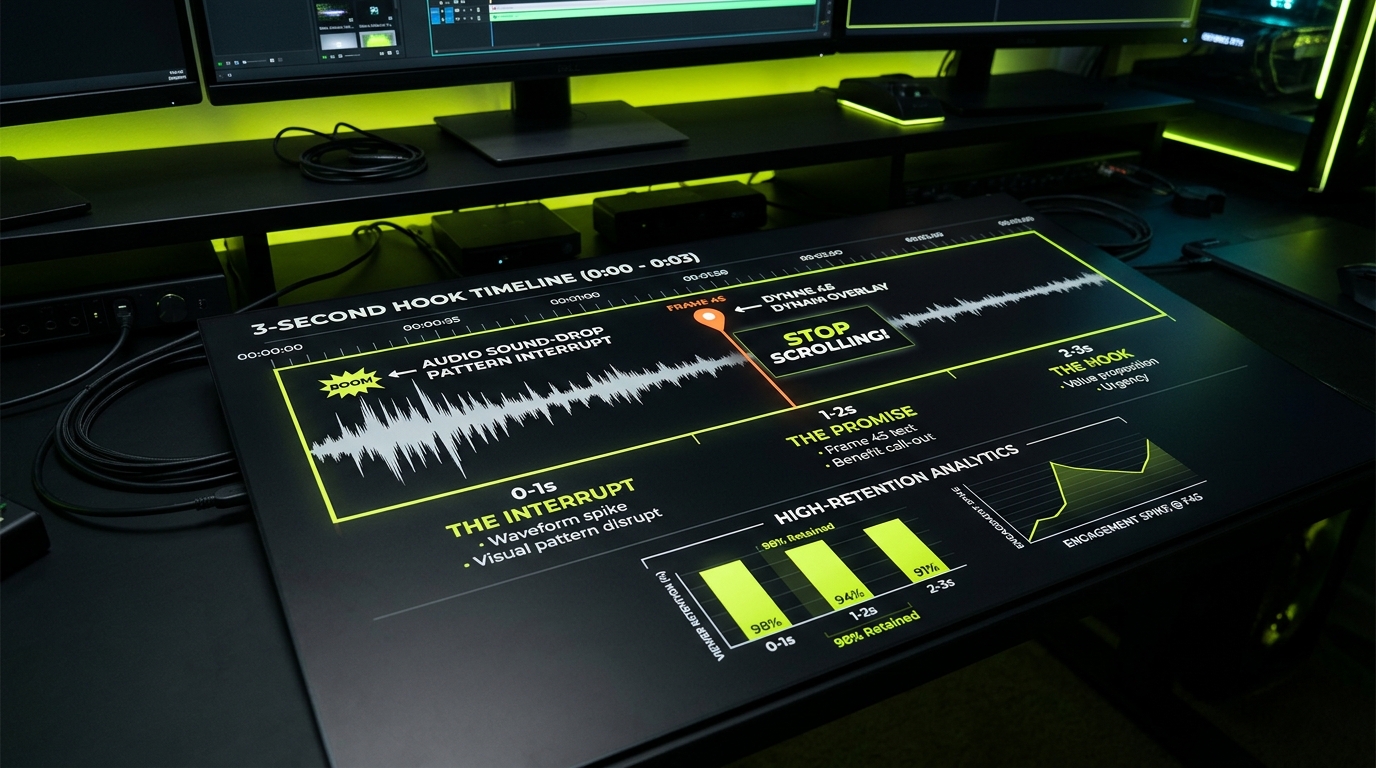
A winning hook is not cheap clickbait — it is relevant qualification. In direct response video production, the first 90 frames (3 seconds at 30fps) must deliver three synchronized micro-elements simultaneously:
- ✓The Visual Disrupter (Frames 0–15): High-contrast movement, quick camera whip-pan, or unexpected first-frame action that violates social feed expectations.
- ✓The Audio Sound Drop (Frames 15–30): Abrupt silence or a custom sub-bass impact riser that signals a break from background noise.
- ✓The Avatar Callout (Frames 30–90): Explicitly calling out the exact identity and late-night pain point ('If you are an agency owner doing over $20k/month...').
3-Second Waveform & Pacing Breakdown
Viewer retention is not linear — it is exponential. If you hold a cold viewer past second 3, their probability of watching past second 30 increases by over 400%.
Below is the exact production timeline used at Seven Figure Studio to calibrate audio waveforms, text overlays, and visual B-roll cuts within the initial 3 seconds.
How to Use an AI Hook Generator for Video Ads
Coming up with 5 to 10 distinct hook angles every week can drain your creative energy. That is why top performance marketers use an AI hook generator to brainstorm contrarian angles, objection callouts, and proof points in seconds.
Our proprietary [Free AI Hook Generator](/ai) generates custom thumbstop angles tailored specifically to your niche, offer, and target audience. Simply input your core promise, and it outputs 5 test-ready hooks instantly.
The 5-Hook Creative Testing Sprint
Never produce a video ad with just 1 hook. That is the fastest way to burn your creative budget. Instead, use the 5-to-1 production ratio:
Film 1 core video body (60 to 90 seconds explaining your mechanism and offer), and produce 5 distinctly different 3-second opening hooks testing contrasting emotional angles.
Deploy all 5 variations into a Dynamic Creative Test (DCT). Within 72 hours, the ad auction will declare a clear winner with a 50% lower cost per acquisition.
- ✓Hook Angle A: The Contrarian Disrupter (Challenging industry belief)
- ✓Hook Angle B: The Proof-First Shock (Verified case study numbers)
- ✓Hook Angle C: The Critical Mistake (Pain point agitation)
- ✓Hook Angle D: The Insider Secret (Exclusivity & curiosity)
- ✓Hook Angle E: The Direct Diagnostic (Avatar qualification question)
Traditional Corporate Video vs. SevenFigureStudio Direct Response
Direct Response Matrix| Creative Lever | Traditional Brand Video | SevenFigureStudio System |
|---|---|---|
| First 3 Seconds | Slow 5-second logo animation, elevator music, or drone footage of a building. | Immediate visual pattern interrupt, sudden sound drop, and instant avatar callout. |
| Pacing & Cuts | Static 5–8 second wide shots. Viewer brain identifies boredom and swipes away. | Dynamic 1.2–2.2 second cuts with relevant kinetic B-roll and zoom transitions. |
| Scriptwriting | Vague corporate buzzwords ('innovative', 'synergistic', 'industry-leading'). | Psychological belief-shifts, naming the unique mechanism, and agitating specific bottlenecks. |
| Audio & Sound FX | Monotonous acoustic guitar or generic royalty-free background loop. | Engineered sound design: sub-bass drops, riser whooshes, and strategic audio silences. |
| Primary KPI | Vanity awareness, impressions, and 'looking cool' to other creative agencies. | Qualified calendar bookings, low cost-per-acquisition (CPA), and scalable ROAS. |
15 Copy-Paste Video Hook Blueprints
These word-for-word opening scripts have generated over $50M in tracked client pipeline across Meta Reels, TikTok Ads, and YouTube Shorts.
The Contrarian Disrupter
“Why 90% of high-ticket coaches are burning ad spend on 45-minute automated webinars when 4-minute video ads are booking twice as many qualified sales calls.”
The Proof-First Shock
“We booked 43 qualified enterprise discovery calls last month using this single 32-second vertical video ad.”
The Expensive Mistake Callout
“The #1 reason your cost per booked call doubled this month — and no, it is NOT the Meta auction algorithm.”
The Insider Agency Secret
“What 8-figure agencies know about direct-response video hooks that traditional creative studios never tell you.”
The Direct Diagnostic Filter
“Are you still relying on manual LinkedIn and Instagram cold outreach to fill your consulting calendar in 2026?”
The 'Stop Doing This' Interrupt
“Stop hiring junior appointment setters until you watch this 2-minute creative breakdown.”
The Math Behind The Lie
“Here is the brutal mathematical reason why your $15,000 retainer proposal is getting ghosted on the 2nd sales call.”
The Behind-The-Scenes Studio Reality
“This is the exact DaVinci Resolve editing timeline we used to generate $3.2M in client pipeline over the last 90 days.”
The Micro-Case Study Flip
“How we lowered customer acquisition cost from $84 to $26 in 14 days without changing the landing page or the offer.”
The Curiosity Gap Question
“What happens when you replace your entire sales development team with 3 client-booking video ads?”
The Unpopular Opinion Callout
“Unpopular opinion: Glossy corporate brand videos are dead for high-ticket client acquisition.”
The 30-Day Velocity Sprint
“If I had to scale a high-ticket consulting business from zero to $50k/month in the next 30 days, this is the only video asset I would launch.”
The Cost-of-Inaction Warning
“Every day your competitors run dynamic creative tests while you run the same 2 video ads, your customer acquisition cost compounds.”
The Algorithm Myth Buster
“Advantage+ and Smart Campaigns did not kill your conversion rate. Your video hook is simply too slow for human psychology.”
The 'Before You Spend $1' Anchor
“Before you spend another dollar on Meta or TikTok ads this week, ask yourself: would you stop scrolling for your own first 3 seconds?”
The Bottom Line
The creative is your ultimate targeting lever in modern algorithmic advertising. By mastering the 3-second hook, you force cold traffic to pay attention, drive down your customer acquisition costs, and position your brand as the undeniable authority in your space.
Key Questions Answered
Direct insights on the 3-second hook rule: 15 video hooks that stopped $50m+ in ad spend scroll
Keep reading
What Is UGC? User Generated Content for Brands, Explained
What is UGC? User generated content explained for brands: types, examples, UGC vs influencer content, costs and how to turn UGC into ads that convert.
Scaling & StrategyUGC Marketing: How Brands Use Creator Videos to Lower CPA
UGC marketing explained: how brands use creator videos in ads to lower CPA, campaign examples, costs, and a 4-week plan to start testing UGC ads.